Overview
A large-scale website migration from WordPress to a headless architecture using Next.js and Payload CMS introduced significant SEO risk. During the migration process, it was discovered that a substantial portion of historically indexed URLs had not been properly accounted for in the migration plan.
An initial technical review by the development team identified that many URLs slated for deprecation still held organic search value. Following that discovery, a secondary SEO audit and coordination effort was conducted to validate migration integrity, assess indexation risk, and identify additional technical and metadata-related issues before they could significantly impact organic performance.
The resulting remediation effort helped the client stabilize the migration, recover organic visibility, and prevent large-scale search equity loss - producing measurable short-term growth and a clear positive impact on search performance within the first reporting period.
The Challenge
The client operated a large website with:
- ~238,000 crawled URLs
- ~178,000 unique URLs identified pre-migration
- 28,176 URLs confirmed as indexed and actively receiving impressions/clicks in Google Search Console
The migration involved:
- Transitioning from WordPress to a headless Next.js frontend
- Implementing Payload CMS
- Reworking routing structures and rendering logic
- Rebuilding metadata and SEO controls within a new architecture
Because of the scale and complexity of the migration, several high-risk SEO issues emerged:
- Indexed URLs returning redirects or errors
- Metadata duplication at scale
- Missing SEO fields due to CMS template inheritance
- Inconsistent heading structures
- Potential search visibility loss from missing page-level optimization
Without intervention, the migration risked substantial organic traffic decline, indexation loss, and ranking instability.
The SEO Audit and Validation Process
A multi-pass validation process was executed to ensure accuracy and identify issues affecting search performance.
The audit focused specifically on:
- 28,176 indexed URLs with measurable organic presence
- Technical crawl validation
- Metadata quality
- Heading hierarchy
- Indexability
- Redirect / error detection
- Canonicalization review
The URL identification process was repeated three separate times to ensure data consistency and eliminate false positives.
At this scale, the audit ran through a Python wrapper around the Screaming Frog CLI that batches a sitemap into 1,000-URL chunks, exports each batch to CSV, combines them into a single workbook, and outputs a summary. The batching is the only thing that makes a 238K-URL crawl tractable on a workstation without hitting the GUI's memory ceiling. The wrapper script is open-source and detailed in a separate journal entry.
Key Findings
1. Large-Scale Meta Title Duplication
- 19,853 meta title errors identified
- 93 exact duplicate meta titles discovered
- Over 24,000 instances where H1s matched meta titles exactly
Using identical H1s and meta titles reduces SERP differentiation and weakens click-through performance. Recommendation: append branded modifiers to titles, generate structured JSON for bulk imports, and improve title uniqueness programmatically.
2. Duplicate and Missing Meta Descriptions
- 1,612 duplicate meta descriptions
- 419 missing meta descriptions
- 23,898 total meta description errors
Root cause: descriptions inherited from shared CMS templates or category structures after migration. Recommendation: programmatically generate descriptions using the page title plus the first visible sentence/content block; investigate Payload CMS automation; implement fallback generation logic.
3. Heading Structure Problems
- 234 pages missing H1 tags
- 72 pages containing multiple H1s
Improper heading hierarchy weakens topical clarity for search engines and degrades accessibility. Recommendation: enforce single-H1 rendering rules in component templates and validate heading structure within reusable frontend modules.
4. Indexed URLs Returning Errors
- 56 indexed URLs returning 308 redirects
- 6 indexed URLs returning 404 errors
- Additional crawl anomalies including 502 responses
Previously indexed, traffic-generating pages were no longer resolving correctly after migration. Recommendation: perform secondary redirect validation, restore or properly redirect historical URLs, prioritize URLs with prior search traffic.
Technical Crawl Summary
| Status | Count |
|---|---|
| 200 OK | 28,176 |
| 308 Redirects | 56 |
| 404 Errors | 6 |
| 502 Errors | 1 |
| Indexable Pages | 28,175 |
| Canonicalized | 1 |
What Went Well
Despite the migration challenges, several important technical foundations remained strong:
- Nearly all critical pages remained indexable
- No pages were blocked by robots.txt
- No missing meta titles were identified
- Large-scale crawl accessibility was preserved
- The majority of URLs successfully returned 200 status codes
These factors significantly improved recovery potential and reduced long-term SEO damage.
Results
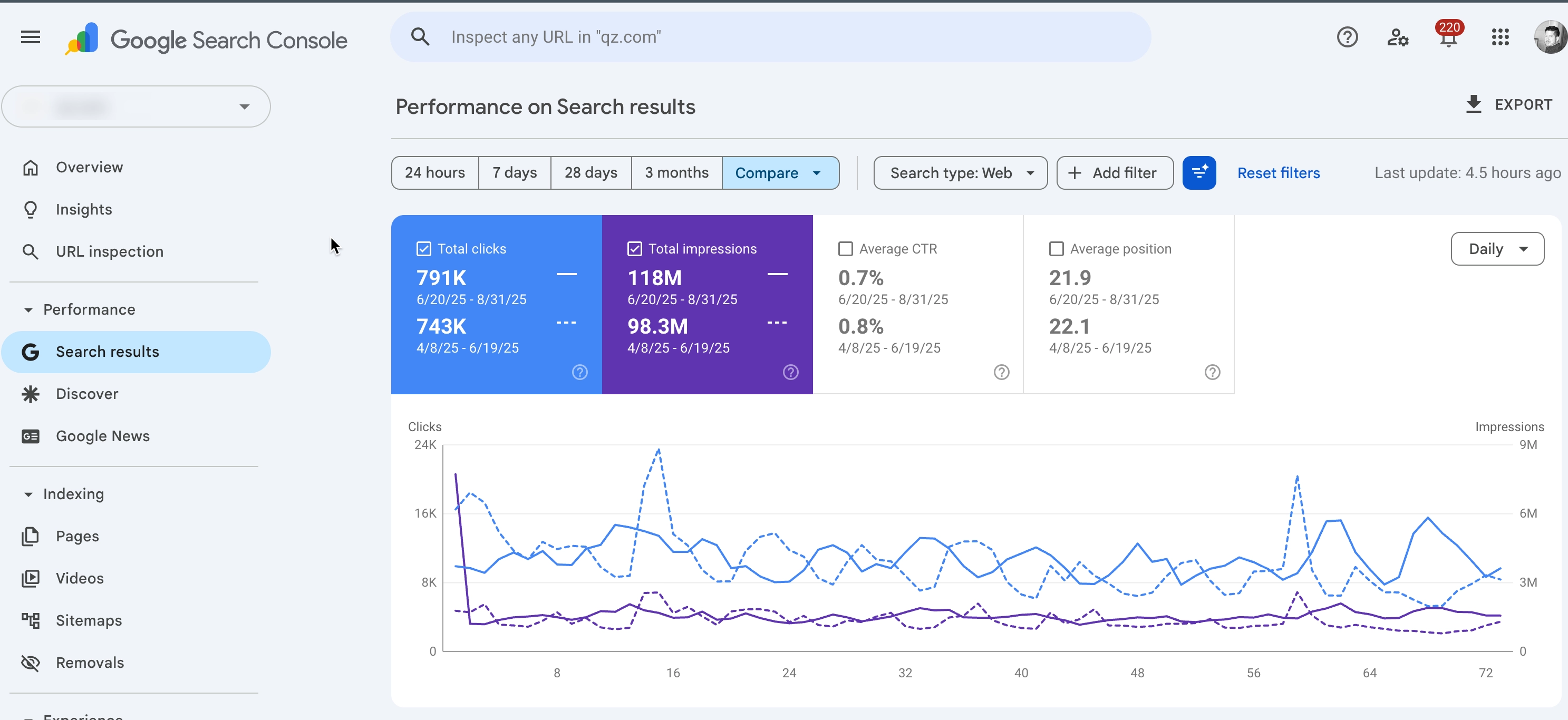
Following remediation and post-migration SEO corrections, the site demonstrated measurable recovery and short-term growth in Google Search Console performance metrics when comparing the post-fix period against the prior baseline period.
Click Growth
- Organic clicks increased from 743,000 to 791,000
- An increase of approximately 48,000 additional organic clicks in the post-fix window
Impression Growth
- Organic impressions increased from 98.3 million to 118 million
- An increase of nearly 20 million additional search impressions
Average Position Improvement
- Average search position improved from 22.1 to 21.9
- Modest in absolute terms, but the direction is what matters - it signalled stabilization and the beginning of ranking recovery following migration corrections
Recovery Validation
The performance trend demonstrated that:
- Critical indexed URLs were successfully preserved
- Search visibility recovered following remediation
- Organic discoverability improved after technical and metadata corrections were implemented
- The migration did not result in the long-term organic traffic loss commonly associated with improperly managed headless CMS migrations
Business Outcome
The coordinated migration QA process, technical SEO audits, and remediation recommendations helped the client:
- Recover search visibility after migration
- Preserve high-value indexed URLs
- Improve organic traffic performance
- Increase total search exposure in Google
- Stabilize rankings during a complex WordPress-to-headless transition
The project ultimately served as a successful example of how proactive SEO validation during enterprise-scale migrations can prevent severe organic performance decline and accelerate post-launch recovery.
Strategic Takeaways
URL preservation must be verified, not assumed. Even when migration plans appear complete, historically indexed URLs must be validated against search performance data, crawl data, and indexation signals before the cut-over.
Headless architectures introduce new SEO failure points. Next.js and headless CMS implementations frequently create metadata inheritance problems, rendering inconsistencies, canonicalization issues, and template-driven duplication. Traditional CMS safeguards often disappear unless rebuilt intentionally.
Post-migration audits are critical. The initial discovery by developers prevented one layer of risk, but secondary SEO auditing uncovered additional technical issues that would likely have continued impacting performance after launch. The follow-up validation process became a critical layer of quality assurance.
By combining technical SEO auditing with migration validation and remediation coordination, the project successfully identified and corrected high-impact SEO issues before they caused irreversible organic performance loss. The client stabilized the migration, corrected structural SEO deficiencies, and recovered search performance following the transition to their new headless architecture - with the GSC numbers above documenting the short-term positive impact on search.